On Aging

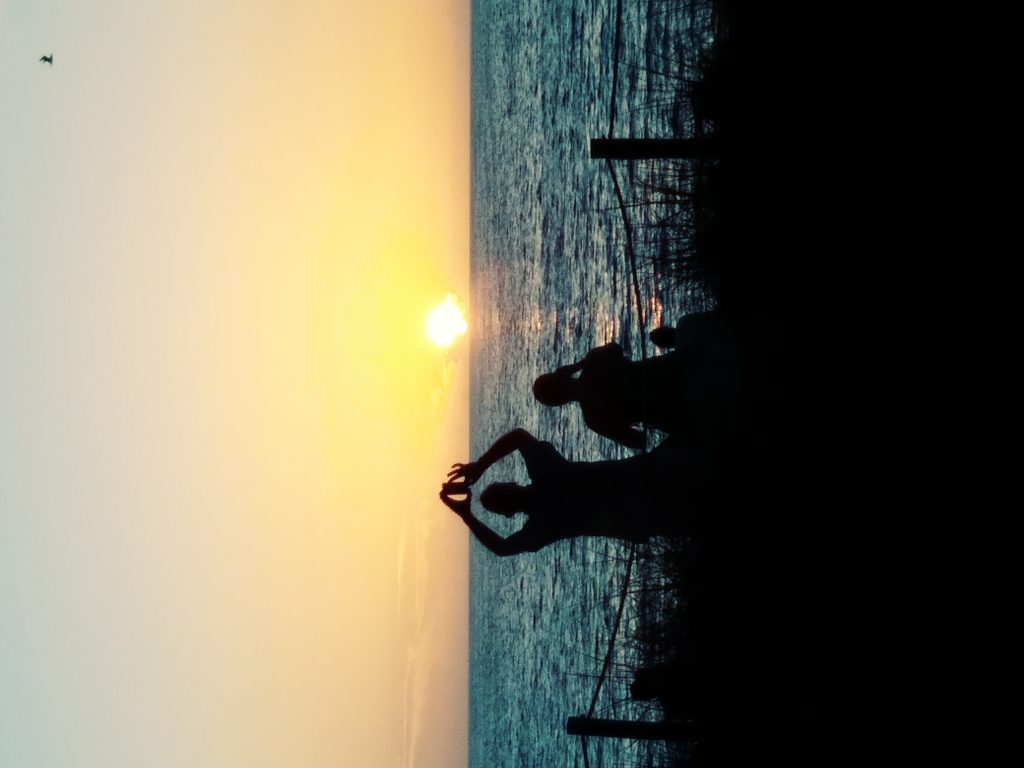
A man and a woman taking photos of sunset on the beach at Captiva Island, Florida
Sunset, Captiva Island

Last week a colleague told a story that touched on her fear of growing old. She was afraid that, after menopause, absent the influence of estrogen and progesterone, her brain would wither and she would become stupid (her word).

Age is the condition for which the word “surreptitious” was created.

It happens gently. The cashier rings our order without making eye contact, and we realize we’ve become invisible. Wait staff our own age call us “honey.” The young man at the hardware store points us toward the aisle instead of walking us there. We can be in denial about some of these at first. It helps us ease in.

New technology grows complicated, and we catch ourselves thinking, “Why can’t they leave well enough alone?” The sassy vulgarity that felt honest and lively in our mouths grows stale as we hear it repeatedly from others. New movies made for a younger demographic do not entertain. Late night talk shows feature people we’ve never heard of with nothing new to say. The music of our youth becomes background music at a restaurant.

Then we start losing words. The name of an acquaintance. The title of a book. A term that we know we know. We laugh and call it a “senior moment,” but every forgetting summons fears of dementia.

So we may not notice at first that the diminishing edge of intelligence is supplemented by the increasing support of memory and experience. Because we’ve seen them before, we recognize patterns and weak spots in policies and people. We’re better at anticipating and preventing, better at patience, better at protest. We know what chances are worth taking. We’re harder to gaslight, quicker to forgive.

And eventually we recognize that we’re ready to slow down, to focus more on our own agendas and less on some institutional one. Do things on our own terms. Break some different rules. We mean it when we say we want more time for family. We say some good-byes and make friends with words like “former” and “emeritus.”

The keen edge of intelligence wears down a bit then, when we stop needing as much of it. Here’s the best part, though: there’s enough. No need for fear. Embrace it – surreptitously if you must, but embrace it.
Teacher fired because … ?

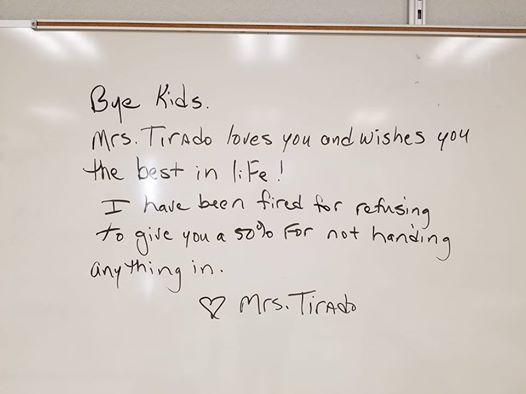
whiteboard with black letters
Mrs. Tirado says good-bye

The photo above is a teacher’s message to her students after being fired. I’m going to play devil’s advocate on this incident. Bear with me.

There’s good math behind the policy that no one receives less than 50% (thank you, Scott West). I adopted this practice myself for the last few years I taught. No one got less than 50%, and students who finally “got it” recovered faster from earlier failing grades. Were there a few who took advantage? Yes, maybe one or two over the years. (You will always have some.) Almost always, students who earned an F received one. Here’s where I differ: I did NOT give 50% for someone who handed in nothing. That remained a zero.

Schools receive funding based in part on how many students graduate. Failing grades cause students not to graduate. A grading policy of not giving grades lower than 50% will help students pass and graduate, and it will help the schools receive more funding. This policy is actually a logical move in the nightmarish assault on public education. It’s better for students (except the 50% for a zero part), and it’s better for schools.

And my final point. This incident as it’s being reported doesn’t make any sense. It looks like a tyrannical administrator fired a saintly teacher, but real life is seldom so black-and-white. We might want to consider that we don’t really know why this teacher was fired; we just know what she says. I want to stand with this teacher. But I also want more information about the situation.

This article suggests some of the complexity of the situation.

Scramble!

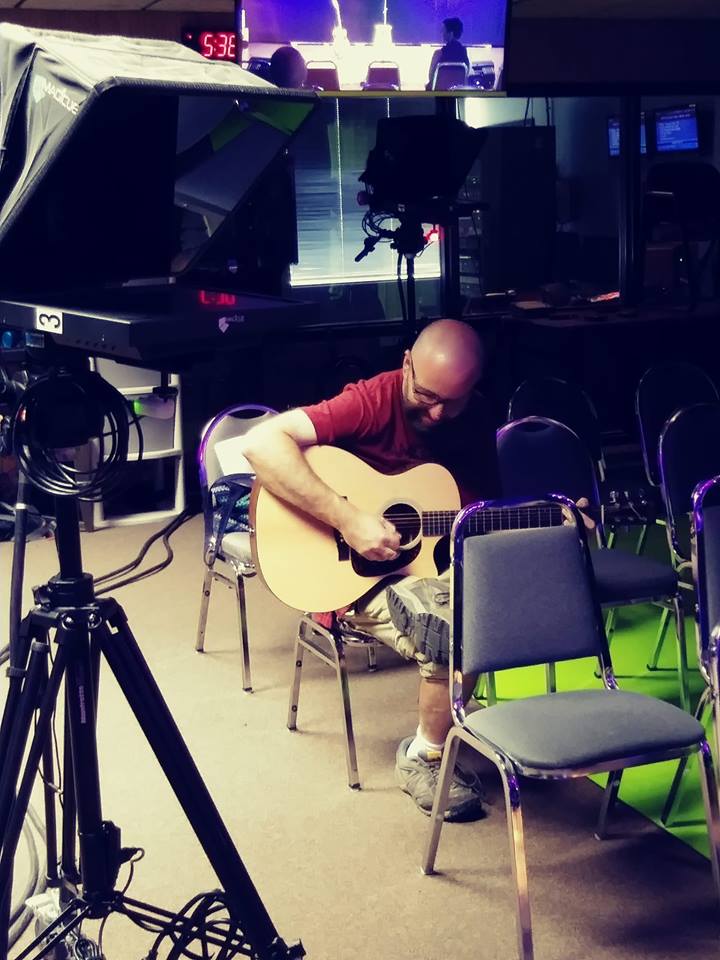
A guitarist strums his guitar in a TV studio.
Warming up for Imagine This!

I’m a talent wrangler for Imagine This! Once a month we invite local acts to share their talent before a studio audience. The show is edited and then replayed on our local cable TV channel. My job is to find and invite performers.

Last Thursday Ron, our emcee, missed our recording session. I sent a text – no response – and it slowly dawned on me that I would be the emcee. I had gone to the show “extra casual” that evening. My hair was a mess, I had no makeup on, my shirt had too “busy” a design for TV, and I hadn’t written down the information that the emcee usually announces.

While the final act recorded, I scrambled: I dug through my purse to find whatever makeup might be available. I set my camera on “selfie” mode to use as a mirror. (Many thanks to whichever high school student showed me that trick!) I wrote notes about the performers. Ron always ended with an inspirational story of some kind — what could I close with? By the time I needed to be ready, I had a little makeup, a comb through my hair, and a vague idea of something to say.

I remember closing with, “That’s our show. You know, every one of our performers tonight started at the same place. They said, ‘I wonder if I can?’ ‘I wonder if I can play that guitar?’ ‘I wonder if I can write a song?'” I don’t remember a syllable that I said after that, but everyone in the studio was watching intently, and someone asked later if I planned a career as a motivational speaker! I had to smile.

They didn’t know I was thinking, “I wonder if I can get through this?”

From now on, it’s back to my Girl Scout motto: be prepared!