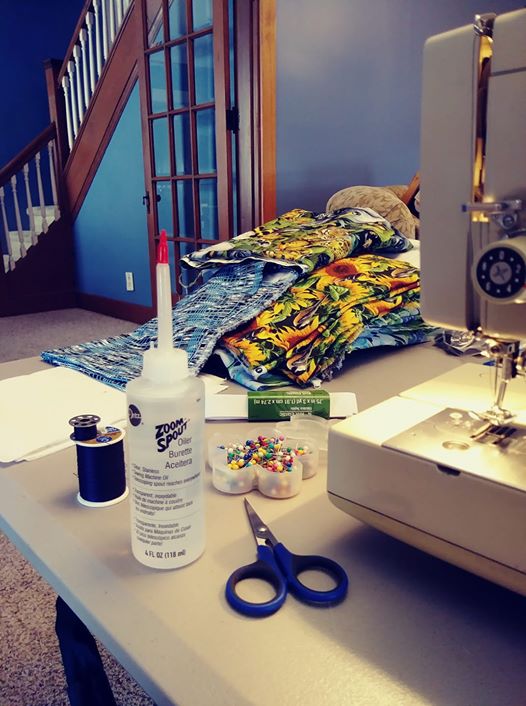
I haven’t sewed anything for years, but when we were asked to wear masks in public, I decided to dust off the 1981 Kenmore and try my hand.
Last night after repeated clumps of thread threatened both my masks and my sanity, I started trouble-shooting. I changed needles. I tightened the tension. I hauled out a can of air and sprayed the bobbin case. No luck. Today I made a trip to Walmart and bought sewing machine oil (and groceries, I promise!). One drop of oil later, I am back in business. One drop.
And because my mind moves to metaphor naturally, I started wondering about other situations in which “one drop of oil” might resolve an issue and get things back on track. A good joke. An apology. A well-timed silence. Finding a point to agree on. A quick negotiation.
It won’t be long before we don’t need these masks. They’ll become part of a Coronavirus documentary we’ll watch 10 years from now and say, “Oh, yeah, I remember those!”
But a drop of oil – we always need those. The trick is to figure out how to be one.
Someday a couple of years from now, someone will open a cardboard box at the back of a hospital storage room and say, “Hey, what are we gonna do with all these masks that we don’t need?” Some of those masks will be mine.
All research indicates that a cotton mask doesn’t really protect much without a filter. It’s just one notch better than nothing. News varies about the filters that go into the masks. Some say to cut up furnace filters. Others say no, the furnace filters contain bits of glass – you don’t want to breathe that in. A few say to cut up vacuum cleaner filters. Coffee filters. Blue shop rags. All of the articles claim that their recommendations are based on reliable research.
I use fusible interfacing, which scored at least as well as coffee filters in one article and which, as it happens, I have. I also figured out how to build in a pocket so that whoever ends up using the mask can add their own filter.
Across the US women are making these masks – the media are doing stories about them. It’s like knitting socks for soldiers in WWI or sewing shirts for them in WWII. This time, we’re trying to help the medical teams. Elastic is hard to come by because all of us mask-makers have bought it out. I started making mine with ties.
I wish I could say my motives are entirely altruistic, but really, I make them mostly to feel useful at a time when I’m being told I’m elderly and should stay home. It gives me something to do besides watch TV and spend too much time on Facebook.
Last night four of us got together at church to serve meals to people, part of an ongoing community program. It was wonderful to spend a couple of hours around people, working, joking, sharing news, making sure everyone is OK. I came home and made another mask, but the task felt stale. I was grateful to realize I had to stop for the night: I’d run out of interfacing.
But this morning I bought more. I ran into someone I know in the fabric aisle at Walmart. She is getting ready to make masks, too, now that everyone is supposed to be wearing them. It was so nice to have someone to talk to. I indulged myself by offering some tips.
So I guess this self-quarantine is starting to wear on me. Even we introverts need human contact now and then.
A week ago today a workman in my home stole a necklace, one I’d had for years. I couldn’t prove anything, but it was gone. Trust destroyed. Lesson learned.
In frustration I said a few words to the thief on Facebook. I supposed that he had converted it into weekend drug money, and I closed the post with these words: “You stole a necklace and got trashed for a few hours. I have happy memories over many years. I win.” I didn’t have a photo, so I googled something close and used it as part of my post.
One of my friends tracked down the maker of the necklace in the post and anonymously sent it to me. It arrived today. (See above.)
When I wear this necklace, I will remember their kindness and generosity of spirit. I’ll do my best to share it. Kindness is real. Lesson learned.